
Ask a teenager in Park Heights what he is good at and you will often get a shrug first.
Not because there is nothing there. Because the city has a habit of treating talent like a hobby until it becomes a problem. A kid who can write a verse in the back of a bus is “creative” until he is standing on the wrong corner with the same voice and no room that will take him seriously.
Dominion Community Development Corporation is planning apartments on a lot that sat empty on Park Heights Avenue. Homes matter. Homes are not the whole afternoon.
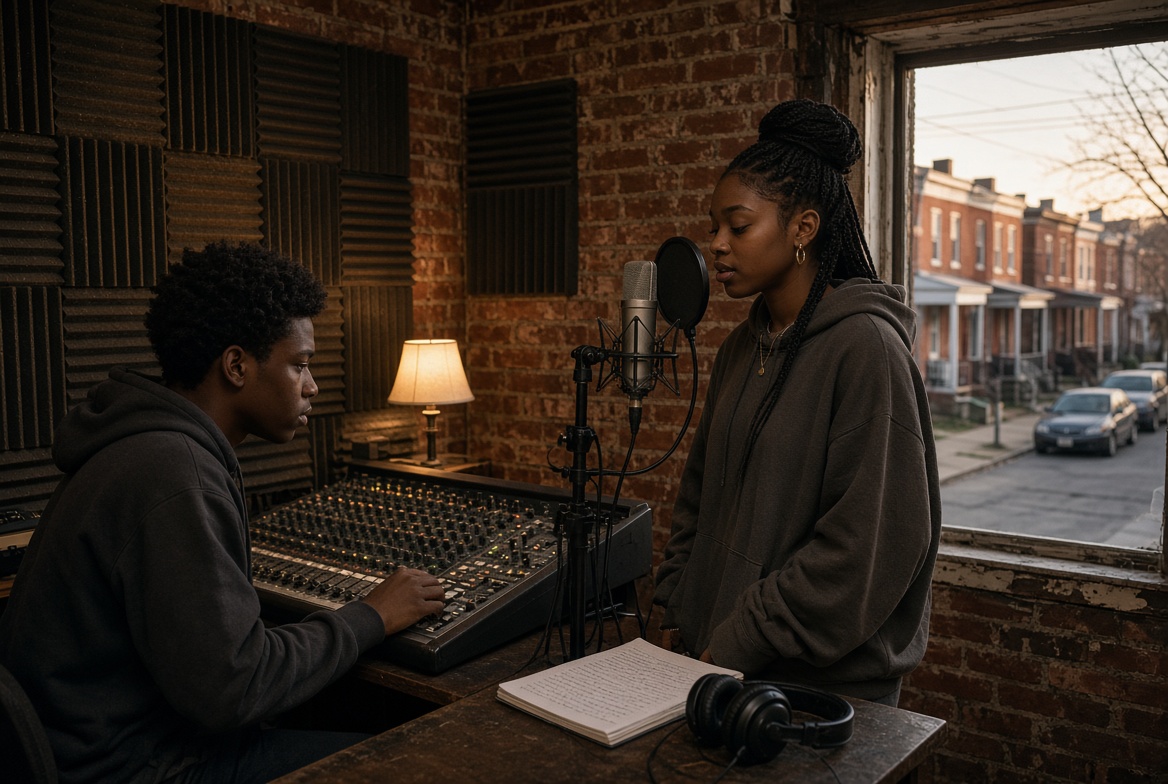
After the last bell, a building is either a place to go or a place to leave. Abe Dua Residences is being designed with a third option: a recording and podcast studio in the same project as the housing. Not a glass booth for a ground-breaking photo. A working room. Mics. Boards. A place to finish a track instead of talking about one.
The 3 p.m. problem
Youth violence work fails when it is only a slogan on a banner. Young people do not need another lecture about potential. They need somewhere to be when the street is loud and the house is crowded and school is done being responsible for them.
Dominion names this directly in its programs: safe spaces, mentorship, recreation, job and life skills. The boxing gym in that same family of ideas runs on a blunt rule — education first. Gloves come after homework. The studio is the same logic with different tools.
A beat is a reason to sit down.
A session has a start time.
A finished song is evidence that the day went somewhere.
That is not soft. That is structure. Structure is what a block uses instead of luck.
Music is already the local industry
Baltimore does not have a talent shortage. It has a finishing shortage.
The neighborhood produces writers, rappers, singers, producers, and kids who can hear a mix before they can name the knobs. What it often cannot produce is a legal, equipped, supervised room within walking distance — and a person in that room who will teach the unromantic half of the work.
The studio program is built around that half. Songwriting. Performance. Beat making. Recording and engineering. Then the parts that keep a gifted 17-year-old from getting eaten: marketing, contracts, business management, how a song actually leaves a phone and becomes money or a credit.
A podcast corner belongs there too. Not every young person wants a hook. Some want to talk. A microphone that belongs to the building says the block’s stories do not have to be extracted by someone driving in with a camera.
If the studio only makes noise, it is a rec room. If it teaches the business, it is workforce development that does not require a young person to pretend he wants to wear a tie on Monday.
Keep the room inside the housing
Putting the studio in Abe Dua Residences is the point.
Amenities that live across town become someone else’s program. Amenities that live in the building become a habit. A mother who gets an affordable unit should not have to put her son on two buses so he can be in a place that treats his voice like a trade.
This is the same argument as the kitchen on West North Avenue and the vacant lot on Park Heights. A loveable community is not a pretty elevation. It is a day that can be lived without leaving: sleep, food, work, and a room after school that is not the corner.
Development without displacement fails if the children of the first residents have nowhere to grow into. Units without a future attached to them are just a slower eviction.
What the studio owes the block
Community studios die in predictable ways. The equipment gets locked up “so nothing happens to it.” The hours only work for adults. The mentor is a volunteer who disappears in February. The room becomes a prop for tours.
The studio will earn the neighborhood when it is booked by people who live nearby, when a session starts on time, when a kid can point to a file and say he made that here, and when the adults in the room care more about the work than the story they will tell at a fundraiser.
Umar’s boxing program, as Dominion describes it, is trying to reclaim young people from the street and keep academic and athletic work in the same building. The studio should be held to that standard. Headphones are not a substitute for school. They are a reason to stay close to it.
If you have a craft, bring it
The useful help is specific.
Producers who can teach a session without making it about themselves.
Engineers who will show a teenager gain before they show him a lifestyle.
People who understand publishing, splits, and why a handshake is not a contract.
Mentors who will still be there after the first month of excitement.
If you grew up on these blocks and you already know the work, the studio needs you more than it needs another outside workshop.
Park Heights has been soundtracked for years by talent that had to leave the neighborhood to be recorded. The bet inside Abe Dua Residences is smaller and harder: give that talent a door it can walk to, treat the gift like a job, and keep the kid close enough that the block still gets him at dinner.
A vacant lot becomes a home. A home becomes a life if there is a room in it worth staying for.