
Hunger in a city rarely looks like the poster.
It looks like a grandmother stretching Sunday into Wednesday. It looks like a corner store where the fruit sits under fluorescent light and costs more than it should. It looks like a cook who can feed a block from memory and still cannot get a health-department kitchen that will take her seriously.
West North Avenue has known all three versions.
That corridor in West Baltimore has plans, history, and too many storefronts that used to mean something. Revitalization language arrives easily. What arrives more slowly is a room where people who already know how to cook can work without leaving the neighborhood to do it.
That is the idea behind Ubuntu Kitchen and Event Space.
Food security is a building problem
Dominion Community Development Corporation lists food security as one of its core programs: gardens, food banks, healthy options, families connected to what already exists. Those pieces matter. A pantry can close a gap for a week.
A pantry cannot give a food-truck operator a place to prep at 5 a.m.
A pantry cannot teach a young cook how to price a plate.
A pantry cannot turn a family recipe into a business that stays on the avenue.
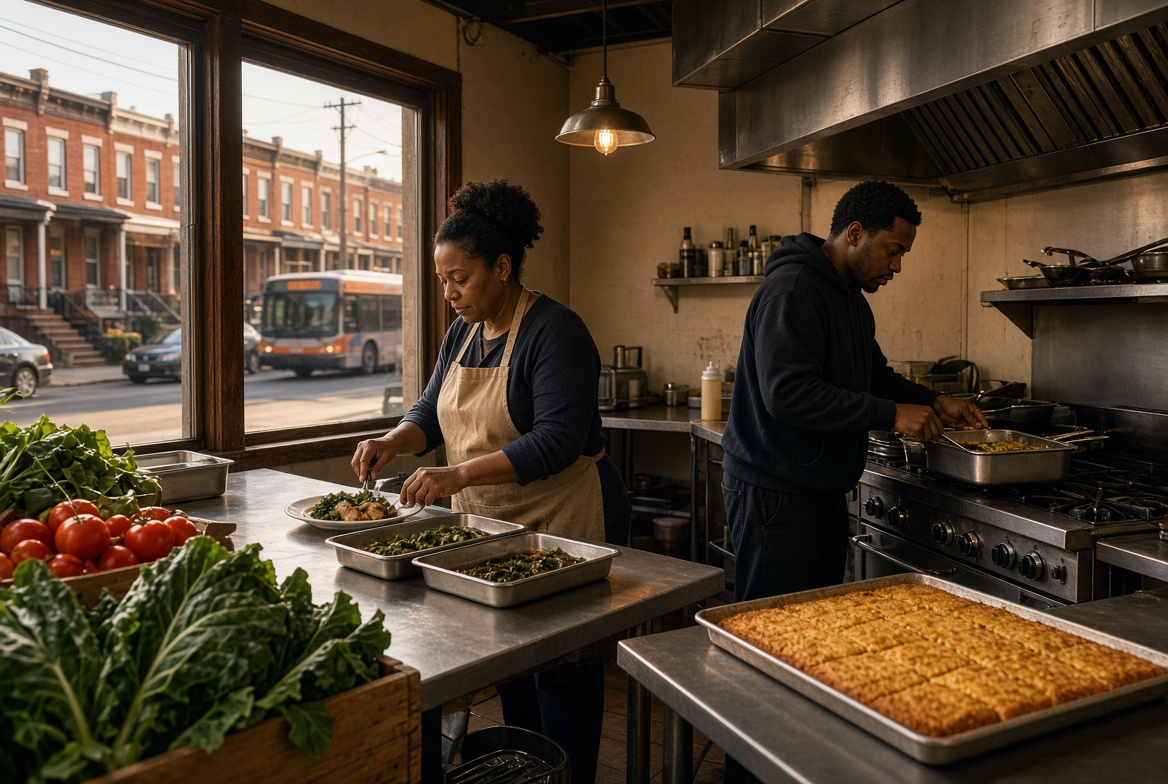
Ubuntu Kitchen is designed as the missing room: a shared commercial kitchen and gathering space for bakers, juice vendors, small manufacturers, food-truck operators, classes, distribution, and the kind of events that make a street feel occupied after dark.
The name is not decoration. Ubuntu is the old idea that a person is a person through other people. A shared kitchen is that idea with stainless steel and a floor drain. One stove used well can hold more than one livelihood.
What the avenue actually needs
West North Avenue does not need another concept restaurant that lasts eighteen months and leaves a dark window. It needs infrastructure that the people already working the corridor can afford to touch.
A commercial kitchen is unglamorous on purpose. Hoods. Coolers. A place to wash pans that will pass inspection. Storage that does not live in somebody’s apartment. A table where a vendor can sit down and do the math before the weekend rush.
Dominion’s plan for Ubuntu also includes something most kitchens skip: an event space. That is not a banquet hall fantasy. It is a recognition that food is how a neighborhood gathers. A kitchen that only produces takeout and never hosts a birthday, a class, or a community meal is only doing half the job.
The project is meant to sit inside the broader West North Avenue and Coppin CDC revitalization work — not as a visitor attraction, but as a tool for the people who already claim the block.
If it works, the measure will not be a ribbon. The measure will be whether a baker on the avenue can say: I did not have to leave West Baltimore to get legal.
Dignity is an ingredient
There is a quiet insult baked into a lot of food-aid language. It treats residents only as mouths.
West Baltimore has always had cooks. It has had fish fry in church basements, platters sold from trunks, juice on the corner in summer, catering that never got a storefront because the rent and the build-out were written for someone else.
Ubuntu Kitchen starts from the other side of that sentence. The neighborhood is not only hungry. The neighborhood is skilled. The gap is equipment, inspection, buying power, and a room that does not disappear when the grant cycle ends.
Shared kitchens work when they are run like a shop floor, not a photo opportunity. Scheduling has to be fair. Fees have to be survivable. Training has to be real — food safety, costing, packaging, how to keep a truck from eating the profit. Dominion has talked about cooperative buying for the vendors who use the space. That is the unsexy part that decides whether this becomes a community asset or a pretty room.
Housing and food belong on the same map
The first story we told from this work was a vacant lot on Park Heights Avenue and the homes planned for it. This story is the other half of a livable block.
A family can move into an affordable unit and still be food-insecure if the nearest decent meal is a bus ride and a markup. A young person can have a roof and still have no after-school place that feels like a future. That is why Dominion keeps housing, kitchens, studios, and mentorship on the same list. They are not four brochures. They are one theory of what a loveable community requires.
People stay when the ordinary parts of life — sleep, food, work, a reason to come home before midnight — can happen without leaving.
If you cook, show up
Ubuntu Kitchen is still being shaped with the people who would use it. That is the only way a shared kitchen survives. Designers can draw a line of equipment. Only a vendor knows whether the door is wide enough for a cambro at 4:30 in the morning.
If you bake, juice, manufacture, or run a truck, the useful move is not to wait for a finished rendering. It is to put your name on the interest list and say what you actually need: cold storage, a certain hood, evening hours, a place to teach, a place to sell.
If you do not cook, the useful move is the same as it was for the vacant lot. Partnership that does not require the avenue to perform its need. Capital. Introductions. Patience. A willingness to let the kitchen belong to the people who will burn themselves on it.
An empty storefront is a rumor that the block is finished. A working kitchen is evidence that it is not.
West North Avenue has fed itself for a long time with too little space to do it in public. Ubuntu Kitchen is the bet that the next chapter of the corridor should smell like supper.